
Domestic Helper Employment Rules in Singapore (2026): Rights and Responsibilities
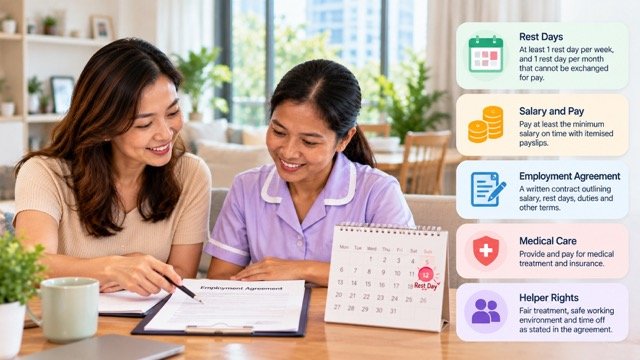
Planning to hire a domestic helper in Singapore, or already working as one? Understanding the employment rules helps employers meet their responsibilities and helps helpers know what to expect. This guide explains the key Ministry of Manpower (MOM) requirements, including rest days, salary payments, medical care, accommodation and fair treatment.
1. Which employment laws apply to domestic helpers?
Migrant domestic workers are not covered by Singapore's Employment Act. This means provisions such as statutory annual leave, overtime pay and public holiday entitlements under that Act do not automatically apply to them. However, employers must comply with MOM's Work Permit conditions and other applicable requirements.
Both parties should clearly discuss the scope of work, salary, rest days, household arrangements and expectations before employment begins. For the hiring process, read our guide to hiring a domestic helper in Singapore.
2. Domestic helper rest day rules in Singapore
Employers must provide their migrant domestic worker with one rest day per week. By mutual agreement, some rest days can be worked in exchange for compensation. However, at least one rest day each calendar month cannot be compensated away and must be taken as a rest day.
- Agree on the rest-day arrangement and communicate any changes in advance.
- Compensate a helper for a rest day worked according to MOM requirements.
- Ensure at least one rest day each month is actually taken.
- Keep a simple record of rest days and any agreed compensation.
3. Salary payments and deductions
Employers must pay the salary agreed with their helper and comply with MOM's salary payment requirements. Salary should be paid promptly, with a clear record of the amount and payment date. Employers must not make unauthorised deductions or keep a helper's salary as a form of control.
There is no general Singapore statutory minimum monthly salary for migrant domestic workers. However, requirements imposed by a helper's home country may apply, and the agreed salary must be honoured. Learn more in our domestic helper salary guide.
Good salary-payment practices
- State the monthly salary clearly in writing.
- Agree on the payment method and keep payment records.
- Explain any lawful, agreed adjustments transparently.
- Do not withhold wages or a helper's personal bank access.
4. Employment contracts: what should be included?
A written employment agreement helps both parties understand expectations and avoid misunderstandings. While Employment Act contract provisions do not automatically apply to MDWs, employers should document agreed terms and meet any applicable MOM or home-country requirements.
| Contract item | What to clarify |
|---|---|
| Salary | Monthly amount, payment date and payment method |
| Rest days | Weekly schedule and compensation for agreed rest-day work |
| Job duties | Housekeeping, childcare, eldercare, cooking or other permitted household duties |
| Living arrangements | Accommodation, meals, privacy and household routines |
| Leave arrangements | Any agreed annual leave, home leave or public-holiday arrangements |
| Communication | How to raise concerns and review expectations |
5. Medical care and insurance responsibilities
Employers are responsible for their helper's medical needs and must obtain the required medical insurance and personal accident insurance. Employers must also comply with applicable medical examination requirements. A helper should not be expected to bear costs that MOM places on the employer.
Read our maid insurance and security bond guide for an explanation of insurance and financial guarantee requirements.
6. Accommodation, food and a safe working environment
Employers must provide suitable accommodation and adequate food. A helper should have a safe place to sleep, reasonable privacy and access to basic necessities. Employers should ensure household tasks can be performed safely and should never subject a helper to abuse, threats or unsafe treatment.
- Provide suitable sleeping arrangements and sufficient food.
- Explain how to use appliances, cleaning products and safety equipment.
- Give clear instructions and realistic time to complete tasks.
- Respect the helper's dignity, personal belongings and privacy.
7. Can domestic helpers receive annual leave or public holidays?
Annual leave and public holiday entitlements under the Employment Act do not automatically apply to migrant domestic workers. Employers and helpers can agree on additional leave benefits, including paid annual leave, home leave or time off for important occasions. Record these terms clearly to avoid confusion.
Do not confuse agreed annual leave with the rest days required by MOM: the weekly rest-day rules still apply.
8. What work can a domestic helper perform?
A migrant domestic worker's Work Permit is issued for domestic work for the approved employer. Employers should not deploy helpers to work for another household, at a business, or outside the permitted scope of domestic work. Check the applicable MOM Work Permit conditions if unsure whether a task is allowed.
For permit-related obligations, see our domestic helper Work Permit guide.
9. Employer and helper responsibilities at a glance
| Employers should | Helpers should |
|---|---|
| Pay the agreed salary on time | Perform agreed, permitted household duties responsibly |
| Provide required rest days and compensation where applicable | Communicate availability, concerns and agreed schedules |
| Arrange required insurance, medical care and accommodation | Follow reasonable household and safety instructions |
| Respect dignity, privacy and personal safety | Treat household members and property respectfully |
| Follow MOM Work Permit conditions | Follow applicable Work Permit conditions |
10. How to handle disagreements fairly
Small misunderstandings can often be addressed through calm, specific conversations. Discuss the issue, listen to each person's perspective and agree on practical next steps. For serious concerns, threats, abuse or suspected breaches of MOM rules, seek help from the appropriate authorities or support organisations rather than attempting to resolve the situation through intimidation.
Employers considering a change of helper can review our transfer versus new helper comparison.
11. Checklist before employment begins
- Confirm eligibility and the correct Work Permit process.
- Agree on salary, payment method and expected duties.
- Discuss weekly rest days and the mandatory monthly rest day.
- Clarify accommodation, food and household routines.
- Arrange required insurance, medical checks and other obligations.
- Write down any additional leave or benefit arrangements.
- Keep copies of relevant agreements and important documents.
Frequently asked questions
Are domestic helpers covered by the Employment Act in Singapore?
No. Migrant domestic workers are excluded from the Employment Act but are subject to MOM Work Permit conditions and other applicable rules.
How many rest days must a domestic helper receive?
A helper is entitled to one rest day per week. Some may be worked by mutual agreement with compensation, but at least one rest day each calendar month must actually be taken.
Are domestic helpers entitled to annual leave?
Statutory annual leave under the Employment Act does not automatically apply to migrant domestic workers. Employers and helpers may agree on annual leave and record the arrangement in writing.
Can an employer deduct a helper's salary?
Employers must follow MOM's salary rules and must not make unauthorised deductions. Any adjustment should be lawful, transparent and properly documented.
Who pays for a domestic helper's medical treatment?
Employers are responsible for required medical care and insurance in accordance with MOM rules. Refer to MOM for the current scope of employer obligations.
Can a helper work in an employer's business?
A migrant domestic worker's Work Permit is for permitted domestic work for the approved employer, not for deployment to a business or another household.
Useful official resources
For current requirements, consult the Ministry of Manpower's Work Permit for migrant domestic workers pages. Official rules take precedence over general online guides.
Looking for a domestic helper in Singapore?
Explore helper profiles and connect directly through DirectHelpers. Review experience, discuss expectations and make informed hiring decisions.
Find HelpersBrowse Helper JobsDisclaimer: This article provides general information, not legal advice. MOM rules and eligibility requirements may change. Verify current conditions with official MOM sources before making employment decisions. DirectHelpers is a marketplace platform, not an employment agency.