
Domestic Helper Levy in Singapore (2026): Rates and Concessions
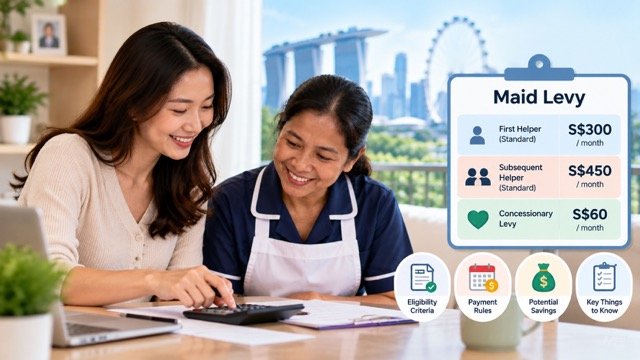
Planning to hire a domestic helper in Singapore? Besides your helper's monthly salary, you must budget for the domestic helper levy paid to the Ministry of Manpower (MOM). The amount depends on whether you are hiring your first or an additional helper and whether your household qualifies for a concession.
This 2026 guide explains the current maid levy rates in Singapore, who qualifies for the S$60 concessionary levy, when payments start, and how to estimate your yearly costs.
What Is the Domestic Helper Levy in Singapore?
The migrant domestic worker (MDW) levy is a monthly government charge that employers pay for employing a foreign domestic helper in Singapore. It is separate from the helper's salary, medical insurance, accommodation and other employment expenses.
Employers generally do not make CPF contributions for migrant domestic workers, but they must pay the applicable monthly levy. The levy is an employer obligation and should not be passed on to the helper.
Domestic Helper Levy Rates in Singapore (2026)
| Levy category | Monthly rate | Annual equivalent |
|---|---|---|
| First helper — standard rate | S$300 | S$3,600 |
| Subsequent helper — standard rate | S$450 | S$5,400 |
| Eligible helper — concessionary rate | S$60 | S$720 |
The annual amounts above assume a full 12 months at the same levy rate. MOM uses daily rates for partial months, so actual first and final bills may differ.
Official source: MOM — Paying levy for a migrant domestic worker.
Who Qualifies for the S$60 Concessionary Maid Levy?
The concessionary levy is intended to support eligible households with caregiving needs. A qualifying person must live in the household, and the applicable citizenship, residency and registration conditions must be met.
1. Households with a young Singapore citizen child
A household may qualify if it includes a Singapore citizen child below 16 years old. For eligible parents, the concession normally begins from the child's date of birth. Other household arrangements may require the child to be added through MOM's FDW eService.
2. Households with an eligible elderly person
A household may qualify if it includes a Singapore citizen aged 67 or above. Some permanent residents aged 67 or above also qualify, depending on their relationship to a Singapore citizen and the relevant household conditions. Address and household records may need to be updated.
3. Households caring for a person with disabilities
Concessions may apply where an eligible person needs assistance with at least one activity of daily living, such as dressing, washing, feeding, toileting or moving around. Medical certification and an assessment through the Agency for Integrated Care (AIC) may be required.
Check the complete conditions at MOM — Levy concession for an MDW.
How Much Can You Save With the Concessionary Levy?
| Example: one helper | Standard levy | Concessionary levy | Savings |
|---|---|---|---|
| One month | S$300 | S$60 | S$240 |
| One year | S$3,600 | S$720 | S$2,880 |
| Two years | S$7,200 | S$1,440 | S$5,760 |
These examples compare levy charges only. Your helper's salary, insurance, food, medical care and other employment costs remain separate.
How to Get the Concessionary Levy
- Check eligibility: Confirm that your household meets MOM's criteria for a young child, elderly person or person with disabilities.
- Update household records: Make sure required household members and residential addresses are correctly reflected in MOM's FDW eService, where applicable.
- Complete any additional assessment: For disability-related concessions, follow the AIC assessment and recommendation process.
- Review your levy bills: MOM says eligible concessions are generally reflected within the next two levy bills, including applicable backdated adjustments.
- Follow up if necessary: Use the relevant MOM enquiry form if the concession does not appear despite meeting all requirements.
Do not assume your concession is active until you confirm the rate shown in your levy records.
When Does the Maid Levy Start and Stop?
According to MOM, for a first-time helper, the levy generally begins on the fifth day after arrival, counting the arrival date. For other helpers, the levy generally starts on the day after arrival. Levy liability ends when the Work Permit is cancelled or expires.
For partial months, MOM publishes daily rates of S$9.87 for the standard first-helper levy, S$14.80 for subsequent helpers and S$1.98 for the concessionary levy. Always use the amount shown on your official bill.
How Do Employers Pay the Domestic Helper Levy?
MOM bills employers for the levy, which is typically paid through the required GIRO arrangement. Employers should keep their payment account funded, monitor bills and follow MOM's instructions for any overdue amount. Late or unpaid levies can lead to penalties and Work Permit-related consequences.
For payment methods, due dates and current penalties, refer directly to MOM's levy payment guidance.
Can You Apply for a Maid Levy Waiver?
A levy concession reduces the monthly levy for an eligible caregiving household. A levy waiver is different: it may apply to certain specific periods or circumstances recognised by MOM. Waivers are not automatic for every situation.
If you think you qualify for a waiver, review the relevant conditions and application process on MOM's migrant domestic worker levy page.
Is the Maid Levy Part of Your Helper's Salary?
No. Your helper's agreed salary is paid to her, while the levy is paid separately to the government. Employers must not treat the levy as a deduction from the helper's wages.
For a complete budget, include monthly salary, levy, food, accommodation, medical care, insurance, rest-day arrangements and other applicable costs. Read our domestic helper salary guide and complete hiring cost guide for more details.
Frequently Asked Questions About Maid Levy
How much is the maid levy in Singapore in 2026?
The standard monthly levy is S$300 for the first helper and S$450 for subsequent helpers. Eligible households may pay S$60 per month per qualifying helper.
Who is eligible for the S$60 maid levy?
Eligible households generally include those with a Singapore citizen child below 16, an eligible elderly person aged 67 or above, or a qualifying person with disabilities. Additional conditions apply, especially for permanent residents and disability cases.
Can I get a S$60 levy for two helpers?
Possibly. MOM allows one concessionary helper per eligible person, capped at two helpers per household. You need two eligible persons to qualify for the concession on two helpers.
Is the maid levy deducted from my helper's salary?
No. The levy is paid by the employer to the government and is separate from the salary owed to the helper.
Does having a newborn qualify for a levy concession?
A Singapore citizen child below 16 may qualify the household. For an eligible parent, the concession generally starts from the child's date of birth, not during pregnancy.
Will my concession appear immediately?
MOM indicates that eligible concessions and applicable backdated adjustments generally appear within the next two levy bills after the requirements are fulfilled.
Planning to Hire a Domestic Helper?
Explore helper profiles and compare candidates directly on DirectHelpers. Remember to account for both your helper's salary and the applicable monthly levy before hiring.
Browse HelpersRead the Hiring GuideInformation note: This article is an informational guide based on publicly available MOM guidance reviewed in October 2026. Eligibility and levy rules may change. Always confirm your circumstances and current charges with MOM. DirectHelpers is a marketplace, not an employment agency or government authority.